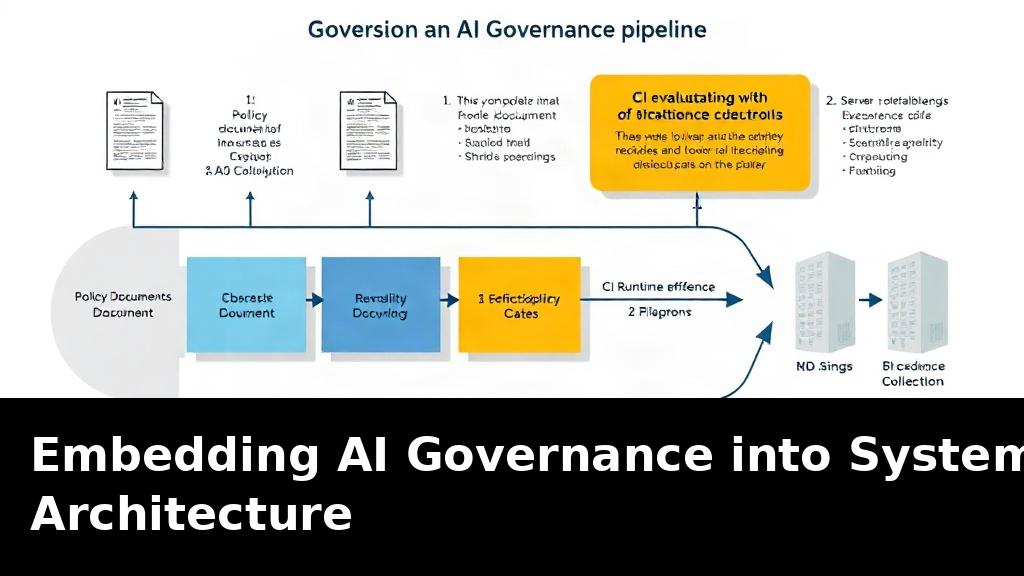
Governance determines whether generative AI initiatives remain limited pilots or evolve into reliable enterprise capabilities. Treating governance as an engineering discipline ensures systems consistently operate within defined policies despite ongoing changes in models, data, and usage patterns.
Governance by design encodes policy requirements into build-time and runtime controls. These controls manage access, restrict actions, record evidence, and detect performance drift. Policies function as executable rules, while evidence emerges automatically from standard operations. This integration allows development teams to accelerate delivery without bypassing necessary safeguards.
Effective implementation begins with a threat model grounded in actual production scenarios. Key risks include exposure of sensitive data through prompts or outputs, prompt injection attacks, compromised source integrity during retrieval, unauthorized tool usage by agents, and gradual drift in model or prompt behavior. Such models guide placement of controls directly in code rather than relying solely on procedural reviews.
Core governance primitives provide reusable building blocks. These include identity context tied to roles and scopes, explicit data boundaries for read and write operations, policy evaluation checkpoints before retrieval or tool invocation, version lineage for prompts, models, and indexes, plus structured audit logs. Implementing these once at a platform level enables consistent application across assistants, copilots, and agentic workflows.
Policy expressed as code allows versioning, peer review through pull requests, and automated deployment. Rules fall into access controls, content restrictions, and action constraints. Each decision emits observable records containing the applied policy version and outcome. Continuous integration pipelines incorporate evaluation gates that run regression tests, quality assessments, and security checks on every change to prompts, retrieval settings, or policies.
Runtime enforcement complements CI processes through request mediation, retrieval filtering, tool validation, and output verification. For agentic systems, tool mediation proves especially critical by enforcing permissions and preventing duplicate operations.
This approach gains additional value when organizations face expanding regulatory expectations around AI accountability. It also promotes tighter collaboration between compliance specialists and engineering teams, ensuring policy intent translates accurately into technical implementation. Evidence captured during normal operation supports both incident response and periodic compliance reporting.
A minimum viable checklist covers documented threat models, version-controlled policy modules, CI gates for quality and safety, runtime controls for identity and access, lineage tracking, secure audit storage, and defined incident response procedures. Organizations that embed these elements report steadier iteration cycles and clearer ownership of AI-related risks.
Feedback loops, including weekly policy reviews and quarterly red-team exercises, keep controls aligned with real system behavior. The result is measurable, repeatable governance that scales with enterprise AI adoption.